_at_IMCMEX_2016_02.jpg)
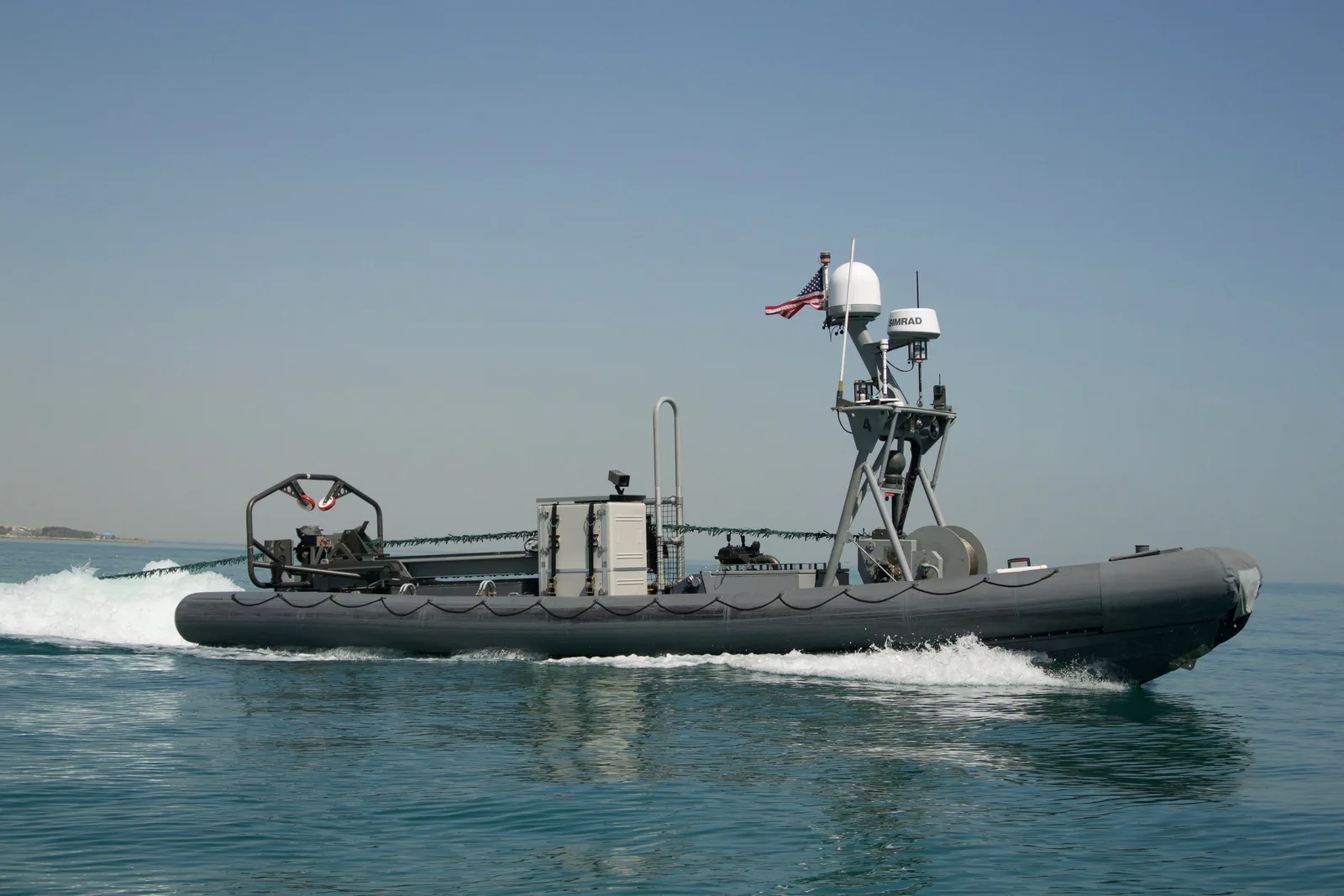
National Defence is seeking a Canadian-designed uncrewed surface vehicle capable of surveying the ocean floor and identifying underwater mines. The request for proposals, published on CanadaBuys on 10 September 2026, is restricted to existing Defence Drone Initiative supply-arrangement holders.
The Department of National Defence (DND) requirement calls for a mine-countermeasures (MCM) vessel that can detect, locate and identify mines while operating either remotely or autonomously. Development would proceed in increments, with successive iterations tailored to Canadian operational requirements.
The requirement offers a potential route for Canadian maritime autonomy and underwater sensing suppliers. Eligibility, however, depends on access to the Defence Drone Initiative (DDI) supply arrangement.
Defence Drone Initiative eligibility limits the MCM competition
The competition is open to current DDI supply-arrangement holders across all streams. The request for supply arrangements closed on 14 August 2026, making qualification under that process the entry requirement for this solicitation.
National Defence launched the DDI in July
National Defence and the Defence Investment Agency launched the initiative on 23 July 2026. Its six use cases range from low-cost disposable platforms to long-range strike systems. Prior defence contracting experience was not required to qualify for the supply arrangement.
The DDI maritime stream covers mine countermeasures
The maritime and subsurface stream includes route surveys, mine countermeasures, monitoring and port security. The proposed MCM vessel falls within that scope, although the stated competition eligibility extends across DDI streams.
Anvil North has separately covered the initial Defence Drone Initiative Marketplace contracts.
Canadian sourcing rules also apply to the MCM USV
The solicitation invokes the National Security Exception and is subject to the federal policy prioritizing Canadian suppliers and Canadian content in strategic procurements.
The National Security Exception changes the procurement framework
The published procurement terms invoke the exception to remove the procurement from Canada’s trade agreement obligations. Alongside the Canadian supplier and content policy, it sets additional procurement conditions beyond DDI qualification. The notice lists no applicable trade agreements and identifies the selection method as the highest combined rating of technical merit and price.
A request for proposals establishes a stated requirement and competition conditions. It does not, on its own, establish a funded program of record, an acquisition quantity, a delivery schedule or a Royal Canadian Navy in-service date.
The MCM request coincided with the Calgary DDI announcement
The solicitation date coincides with the 10 September Calgary announcement by Prime Minister Mark Carney and Ukrainian President Volodymyr Zelenskyy on the DDI Marketplace Supply Arrangement. Nearly 400 Canadian suppliers qualified for the marketplace, which Ottawa describes as modelled on Ukraine’s Brave1.
DDI contract announcements carry an evaluation caveat
Canada announced initial contracts worth up to C$50 million and said the purchases would increase Canadian Armed Forces drone numbers tenfold. Carney put the existing fleet at about 2,000 drones, said future needs would reach millions, and stated that one-third of Canadian drone production would support Ukraine’s defence.
The accompanying backgrounder used more conditional language: Canada intended to proceed after evaluations, including foreign ownership, control and influence assessments. That distinction matters when identifying completed awards and their recipients.
Anvil North has also covered the Canada–Ukraine partnership on drone training and production.
MINERVA is a separate Canadian Army procurement track
The MCM requirement is distinct from the Canadian Army’s MINERVA Initiative. MINERVA runs through Innovative Solutions Canada at Innovation, Science and Economic Development Canada, rather than through the DDI marketplace.
Six MINERVA challenges cover air and ground systems
National Defence is releasing six challenges through August and September 2026:
- Arctic Uncrewed Air System.
- Intelligence Air Surveillance and Reconnaissance.
- Uncrewed Aircraft System Deconfliction.
- Uncrewed Air System for Cargo-Munition Drop.
- Uncrewed Ground System for Surveillance and Reconnaissance.
- Uncrewed Ground System for Tactical Cargo Movement.
Innovative Solutions Canada provides up to C$2.5 million in total per challenge, rather than C$2.5 million for each award. Each is a Phase 2 prototype-development competition covering technology readiness levels 5 to 9. The Arctic Uncrewed Air System challenge, including its −40°C requirement, is covered separately.
MINERVA demonstrations ran at Valcartier and Petawawa
Canadian Army demonstrations took place at Canadian Forces Base Valcartier on 10 August and Garrison Petawawa on 19 August. A further discussion on uncrewed aircraft system deconfliction is planned for late September at Canadian Forces Base Gagetown.
Canadian suppliers cover several parts of the MCM requirement
An autonomous mine-countermeasures vessel needs a hull and autonomy system, together with sensors and processing capable of finding and identifying mines. Anvil North tracks Canadian capabilities relevant to these functions.
Sonar and processing are central to the MCM mission
The requirement to detect, locate and identify mines on the ocean floor makes sensing and signal processing central to the mission. Anvil North’s assessment is that supplier analysis should give these functions as much attention as the vessel and autonomy system. The available description does not establish how DND will weight them in bid evaluations.
Kraken Robotics supplies synthetic aperture sonar and subsea power
Kraken Robotics, based in Mount Pearl, Newfoundland and Labrador, builds synthetic aperture sonar and subsea power systems and sells sonar internationally. The reporting cited below places its workforce at roughly 450 across Canada, the United States, Brazil, Britain and Germany.
Kraken’s atlas entries cover KATFISH towed synthetic aperture sonar and SeaPower subsea energy systems. Those capabilities make Kraken a prominent Canadian supplier to examine for the sensing element of the requirement; they do not establish participation in this competition.
OSI, GeoSpectrum and Nautel cover other maritime functions
British Columbia-based OSI Maritime Systems supplies navigation and warfare systems. GeoSpectrum Technologies and Nautel Sonar work in underwater acoustics from Nova Scotia.
Under Anvil North’s methodology, an atlas entry records a stated or evidenced capability. It does not confirm that a supplier is eligible, has bid, has been shortlisted or has received an award under this solicitation.
What to watch next in the DND mine-countermeasures competition
The CanadaBuys notice lists solicitation WS5872432708, under procurement reference W8472-275993, with a closing deadline of 8 October 2026 at 2 p.m. Eastern Daylight Time. The notice was last amended on 21 September. Further amendments and the final closing deadline remain the immediate items to monitor.
Further disclosures should establish whether DND has specified a quantity, an in-service target or a relationship to an existing Royal Canadian Navy program. The solicitation does not establish an MCM USV dependency in the Victoria-class and surface fleet renewal files, including the Canadian Patrol Submarine Project and River-class destroyer.
Other items to track are confirmed DDI award recipients and values, the opening of the sixth MINERVA challenge, and whether the Gagetown deconfliction session proceeds as planned.