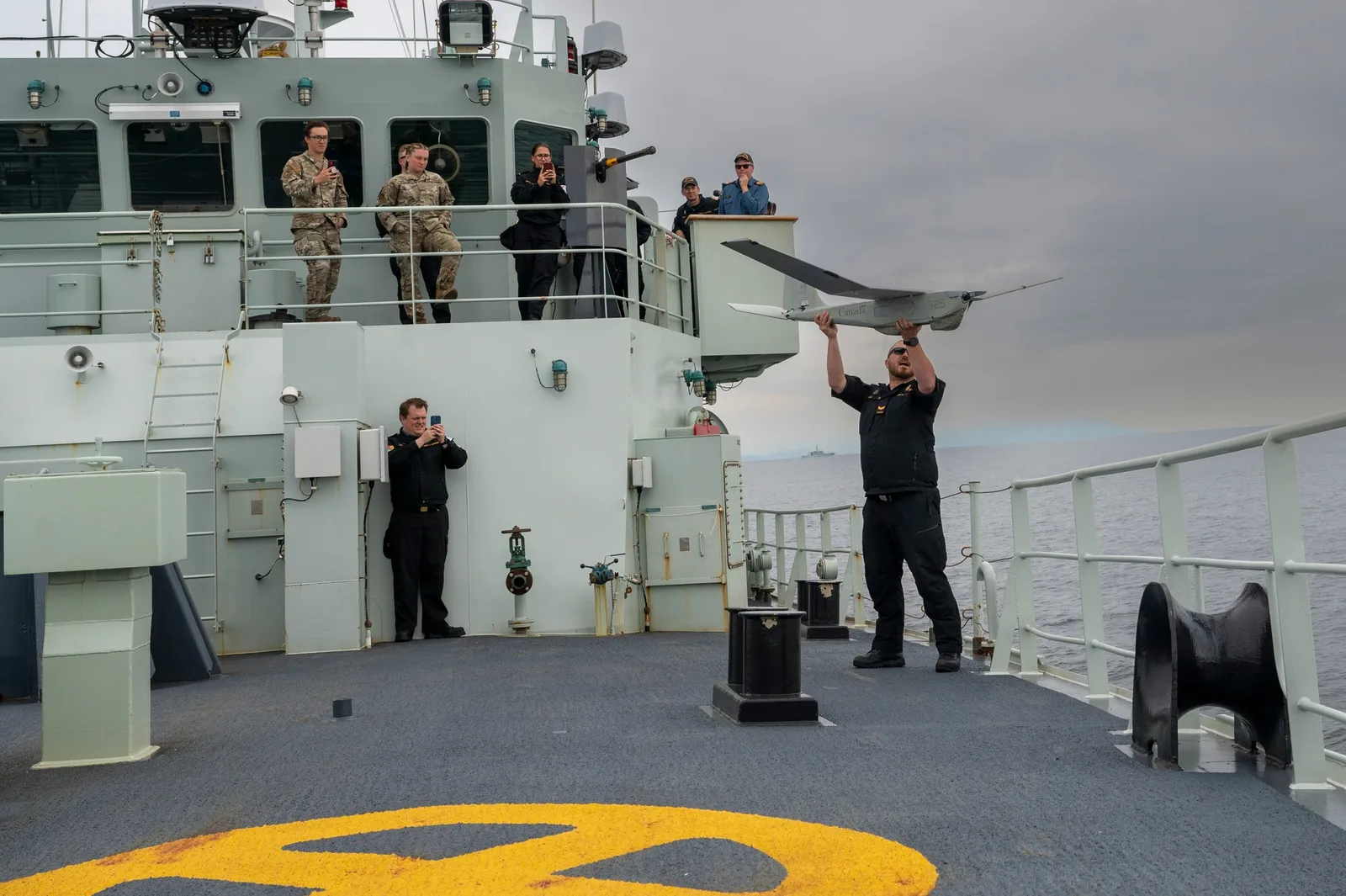
On 10 September, Canada announced initial contracts worth up to $50 million through its Defence Drone Initiative Marketplace for intelligence, surveillance and reconnaissance drones and uncrewed ground vehicles. The awards move the program from qualifying suppliers into purchases for the Canadian Armed Forces.
Ottawa named Beonyx, AVSS, Volatus Aerospace, Twenty20 Insight, Draganfly and Objexis AI as suppliers. Training, maintenance, repair, configuration and sustainment under the initial contracts must take place in Canada, giving the procurement a domestic support requirement alongside the equipment purchases.
However, the scale of subsequent orders remains open. Volatus’s disclosure illustrates the difference between securing an initial purchase and having a framework through which Canada could acquire substantially more systems.
From marketplace access to orders
Launched on 23 July, the Defence Drone Initiative is led by the Department of National Defence and Defence Investment Agency. It connects Canadian Armed Forces and Canadian Coast Guard requirements with industry through mechanisms including testing and operational feedback.
The marketplace is modelled on Ukraine’s Brave1 system. Qualifying for its supply arrangement allows a company to compete for subsequent work; the government explicitly says qualification does not guarantee a contract.
In effect, marketplace admission, a contract award and delivery are separate steps. The September awards demonstrate progress through that process, while acceptance of the equipment remains a further measure of whether the purchases are becoming fielded capability.
Volatus’s initial tranche is 100 systems
Volatus Aerospace disclosed a five-year contract for low-cost tactical intelligence, surveillance and reconnaissance (ISR) uncrewed aircraft systems. The initial order covers 100 systems, with options for Canada to acquire another 4,900. Those options are not committed purchases, backlog or revenue.
The company says the procurement framework permits up to $25 million and sets a $5,000 maximum per system. Its own contracted pricing is confidential. The framework figures therefore describe a ceiling; they do not establish the value of the first order.
Deliveries of the initial tranche are expected to begin in the fourth quarter of 2026. The package includes aircraft, payloads, ground control equipment, data links, training, spares and continuing technical support.
That scope matters to the industrial outcome. In Anvil North’s assessment, repeat orders and continuing support work could give suppliers a more predictable basis for production and staffing. The disclosed options offer room for expansion, but companies would still need further purchasing decisions before treating that volume as demand.
A separate route through Ukraine cooperation
Also on 10 September, General Dynamics Mission Systems–Canada announced a memorandum of understanding with Ukrainian manufacturer GreenTech Harvest to explore uncrewed aerial vehicle co-production for Ukraine. The proposed collaboration combines Ukrainian designs and operational experience with Canadian manufacturing capabilities.
The memorandum provides a framework for industrial cooperation without announcing a production quantity, delivery schedule or contract value. It is therefore at a different stage from the purchases awarded through Canada’s drone marketplace.
Together, the developments open routes to equipment orders, domestic support work and potential co-production. Their industrial value will depend on how much recurring work follows: the marketplace has generated initial purchases, while the Canadian–Ukrainian collaboration still needs production agreements to establish its scale.