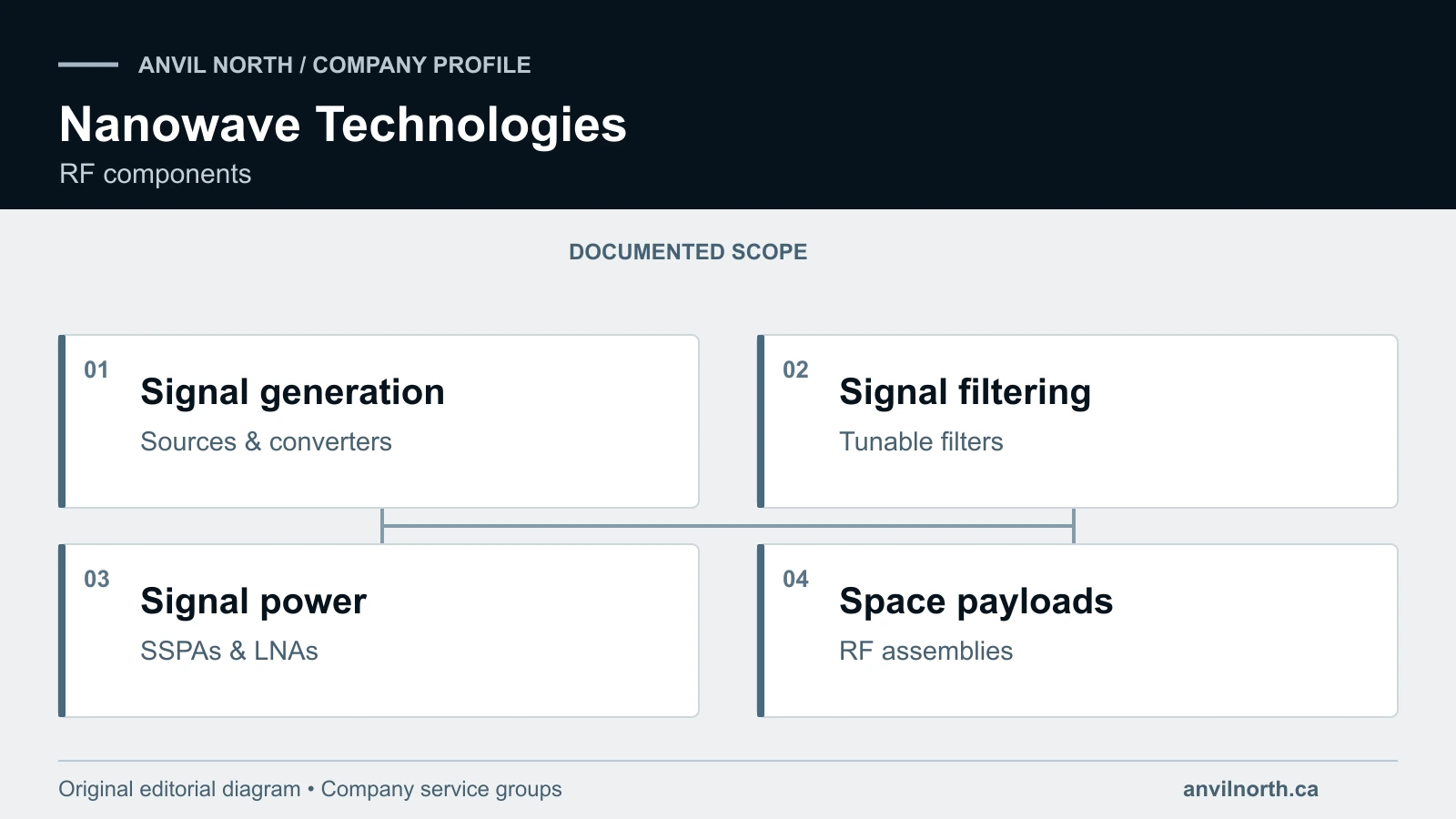
Nanowave Technologies makes RF parts for radar, radios and space payloads. The firm works from Etobicoke, Ontario, and sells several types of RF equipment. Its range includes power amplifiers, low-noise amplifiers, filters and frequency sources. Each part has a distinct role within a larger system.
What does Nanowave Technologies manufacture?
Nanowave’s product range spans microwave and millimetre-wave parts, modules and assemblies. These parts help a system create, boost, filter or convert signals. The firm lists uses on aircraft, ships, ground equipment and spacecraft.
An RF part supplies one of the functions that a radio or radar needs. Other parts handle tasks such as power, data processing and antenna control. Nanowave’s product pages describe its equipment, without claiming to build complete aircraft or satellites.
That scope helps place Nanowave within Canada’s electronics and aerospace supplier base. Aversan’s electronics engineering work covers a different set of design and test tasks. Two firms can serve the same market without working on the same program.
How do Nanowave’s RF product families differ?
Nanowave’s amplifier range includes solid-state power amplifiers, low-noise amplifiers and broadband products. It sells these as modules, transmitter units and rack-mounted equipment. The tables for each model list its frequency, output, size and temperature limits.
Start a product comparison with the signal that needs work. A power amplifier and a low-noise amplifier meet different needs within that signal path. Check the model’s data sheet against the role it must fill.
| Product family | Role | What to compare |
|---|---|---|
| Solid-state power amplifier (SSPA) | Boosts RF power | Frequency, output, mode and cooling |
| Low-noise amplifier (LNA) | Boosts weak signals with low added noise | Bandwidth, noise and interfaces |
| Sources and converters | Creates signals or changes their frequency | Stability, reference and frequency range |
| Electronically tunable filter (ETF) | Adjusts which signals pass through | Tuning range, bandwidth and switching |
| Space RF payload equipment | Performs RF tasks within a space payload | Mission, interfaces and test evidence |
The sources and converters range includes oscillators, synthesizers and direct digital synthesis products. A source creates a signal for another part of the system. A converter changes its frequency, which differs from boosting its power.
Nanowave’s electronically tunable filters serve radar, communications, electronic warfare and signal intelligence. These filters let the user adjust centre frequency and bandwidth. Check the chosen model’s tuning range and controls before specifying it.
Which space applications does Nanowave describe?
Nanowave lists RF payload equipment for low, medium and geostationary Earth orbits. The range includes amplifier assemblies, frequency converters and transmit-receive modules. Its product pages describe power, control and monitoring features for these units.
The space range provides RF functions within a spacecraft’s payload. It does not make every Nanowave product suitable for every space mission. Buyers need test evidence for the chosen unit and its intended use.
RF payload equipment also fills a different role from a spaceport. Maritime Launch’s work in Nova Scotia concerns launch facilities and access to space. Nanowave’s space products handle signals once they form part of the payload.
What should an RF equipment enquiry specify?
Tell the supplier which signal function the equipment must perform. Include the frequency band, power needs and space available for the unit. These details help narrow the choice to products that fit the task.
| Topic | Details to share | Why it matters |
|---|---|---|
| Signal path | Boost, create, convert or filter | Selects the product family |
| Electrical needs | Band, bandwidth and output | Narrows the model choice |
| Physical fit | Power supply, controls and size | Checks system interfaces |
| Environment | Ground, air, sea or space use | Sets the test needs |
| Delivery | Tests and records needed with the part | Defines the supply scope |
This table helps frame an enquiry; Nanowave sets its own acceptance terms. Agree on the tests and records needed for the chosen part. Canada’s space supplier directory covers other firms involved in space work.
Nanowave Technologies: common questions
Where does Nanowave Technologies operate in Canada?
Nanowave Technologies has a Canadian operation in Etobicoke, within Toronto, Ontario. Its official website lists products and provides a route to the sales team. Include the product family or model when asking about a part. That gives the team a clearer starting point than a broad request about the firm’s work.
Does Nanowave manufacture complete satellites?
Nanowave’s space range covers RF payload equipment, rather than complete satellites. Its parts can boost signals, change their frequency or control their path. A satellite also needs structures, power, flight controls and other systems to work. Buyers should match Nanowave’s range to the RF tasks within their own spacecraft design.
What is the difference between Nanowave SSPAs and LNAs?
Nanowave SSPAs boost RF power, while its LNAs amplify signals with low added noise. These roles call for different checks when choosing a part for a system. The firm gives each model its own set of electrical and mechanical data. Start with the signal path, then check the model against its specific needs.
What are Nanowave electronically tunable filters?
Nanowave electronically tunable filters let a system adjust which signals pass through. Their controls change the centre frequency and bandwidth within each model’s limits. The firm lists uses in radar, communications, electronic warfare and signal intelligence. A buyer needs to check how fast and how far the chosen filter can tune.
Are all Nanowave products suitable for space missions?
Nanowave has a space range as well as products for other settings. A firm’s space work does not qualify all its products for flight. Check the chosen unit against the mission’s power, size and test needs. Ask for the records that show how that unit meets the agreed scope of supply.
How can buyers compare Nanowave with other Canadian suppliers?
Nanowave comparisons work best when buyers define the RF task first. A firm that designs electronics may offer a broader set of engineering services. A cable maker supplies another part of the same system’s signal path. Compare the work each firm can take on, then check the evidence for that work.
Follow Anvil North Weekly for news on Canadian defence firms and programs. Each edition links the week’s developments to their sources and wider context.
Sources
- Nanowave company and product information
- Product portfolio
- SSPAs, LNAs and broadband amplifiers
- Sources and converters
- Electronically tunable filters
- Space RF payload equipment
Earlier identity and portfolio references retained from the 13 September profile review: