_Pilatus_PC-21_at_Wagga_Wagga_Airport.jpg)
The first two CT-157 Siskin II trainers arrived in Canada on 17 September 2026, marking the next step in preparations for SkyAlyne’s C$11.2-billion Future Aircrew Training program. The arrival brings the aircraft closer to acceptance by the Royal Canadian Air Force; training under the new system is expected to begin in spring 2029.
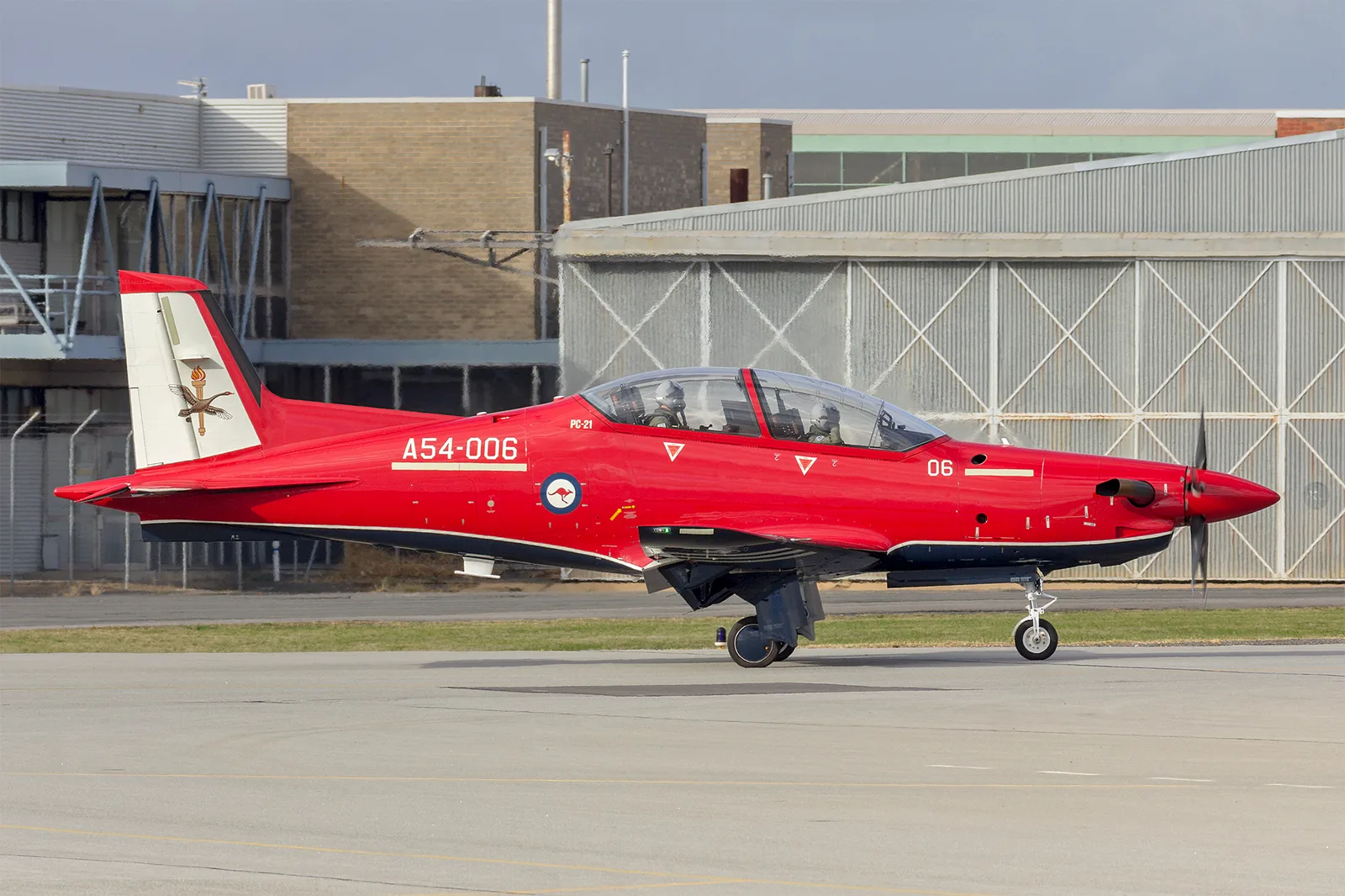
SkyAlyne reported that representatives of the Royal Canadian Air Force (RCAF), Pilatus, KF Aerospace and CAE welcomed the aircraft on the morning of 17 September. The CT-157 Siskin II is Canada’s designation for the Pilatus PC-21 advanced trainer.
SkyAlyne scheduled the aircraft for the Aero Gatineau-Ottawa Air Show on 19 and 20 September before onward transfer to 15 Wing Moose Jaw, where the fleet will be based. SkyAlyne has ordered 19 Siskin IIs.
CT-157 Siskin II arrival starts the next stage of FAcT preparation
SkyAlyne says final delivery to the RCAF takes place when the aircraft reach 15 Wing Moose Jaw. The trainers will then support development and testing of the Future Aircrew Training (FAcT) system, including training instructors for the new ab-initio program.
CT-157 Siskin II supports two advanced flying courses
The Siskin II is assigned to Advanced Flying Training – Fixed Wing and Advanced Flying Training – Jet. The two-seat aircraft uses a 1,600-horsepower Pratt & Whitney Canada PT6A turboprop, reaches 685 km/h and is rated from positive 8G to negative 4G.
Pilatus milestones preceded the Canadian arrival
The first production test flight took place at Pilatus’s Stans facility in Switzerland on 26 February 2026 and lasted about one hour and 15 minutes. Factory acceptance followed in May at a ceremony attended by Secretary of State for Defence Procurement Stephen Fuhr and Jean-Paul Lemieux, Canada’s ambassador to Switzerland and Liechtenstein. September’s arrival is the third public milestone in that delivery sequence.
Arrival and public display do not, by themselves, establish RCAF acceptance, aircraft availability or readiness of the wider training system. SkyAlyne is the source for the arrival; its announcement does not establish completed RCAF acceptance.
Canadian content in the Pilatus PC-21 remains unquantified
SkyAlyne says every PC-21 built for customers worldwide contains Canadian components, including the powerplant and parts of the avionics system. That claim applies to global production, not just Canada’s 19 aircraft.
The PT6A is the identified Canadian powerplant. SkyAlyne describes the avionics contribution in general terms and has not published a supplier breakdown, dollar value or percentage of Canadian content, either per aircraft or for the FAcT fleet.
The statement therefore establishes a claimed Canadian contribution, but does not establish the size of the domestic work share.
SkyAlyne divides FAcT delivery between CAE and KF Aerospace
SkyAlyne is the partnership that CAE and KF Aerospace formed in 2018 to compete for FAcT. CAE holds a 25-year subcontract worth approximately C$1.7 billion for simulators, training devices and training delivery. A follow-on agreement for in-service support is expected.
CAE extends its training role at 15 Wing Moose Jaw
CAE’s work spans training systems integration and training services and sustainment, extending its existing presence at Moose Jaw.
KF Aerospace covers Southport and fleet airworthiness
KF Aerospace runs the Southport site and multi-engine training stream, and is responsible for maintenance and airworthiness across all five FAcT fleets. REDspace holds a separate SkyAlyne contract to modernize aircrew training.
FAcT must bridge the transition from existing RCAF training contracts
Public Services and Procurement Canada (PSPC) says FAcT replaces two contracted training arrangements. CAE Military Aviation Training delivers NATO Flying Training in Canada at 15 Wing Moose Jaw under a contract expiring in 2027, with one option year extending to 2028. Allied Wings delivers Contracted Flying Training and Support at Southport under a contract expiring in 2027.
FAcT also takes in air combat systems officer and airborne electronic sensor operator training, which the RCAF currently delivers itself. SkyAlyne training is expected to begin in spring 2029 at Moose Jaw, Portage la Prairie and 402 Squadron at 17 Wing Winnipeg.
Anvil North’s assessment is that the transition between the existing contracts and the 2029 start remains the central schedule issue. The arrival of two trainers is an early contribution to that transition; it does not settle how the intervening period will be covered.
The RCAF’s five FAcT fleets total 71 aircraft
FAcT procures more than 70 aircraft across five fleets. The designations and liveries revealed by the RCAF at CANSEC 2025 covered 71 aircraft.
CT-102B Astra II: 23 Grob G120TP basic trainers
The Grob G120TP enters service as the CT-102B Astra II for basic flight instruction at 15 Wing Moose Jaw, succeeding the CT-102A Astra.
CT-157 Siskin II: 19 Pilatus PC-21 advanced trainers
The PC-21 fleet supports both advanced fixed-wing and advanced jet training at Moose Jaw under the CT-157 Siskin II designation.
CT-145E Expeditor II: seven Beechcraft King Air 260 aircraft
The King Air 260 enters service as the CT-145E Expeditor II. KF Aerospace will operate the fleet from Southport for multi-engine certification.
CT-153 Juno: 19 Airbus H135 helicopters
The CT-153 Juno replaces the Bell CH-139 and Bell 412CF as the RCAF’s primary rotary-wing trainer. Airbus completes and delivers the helicopters from Fort Erie, Ontario. The H135 is the first Airbus helicopter type to fly with the Canadian Armed Forces.
De Havilland Dash 8-400: three mission-training aircraft
Three Dash 8-400 aircraft will carry cabin-mounted mission training systems for air combat systems officers and airborne electronic sensor operators at 17 Wing Winnipeg.
The first two Grob G120TPs arrived at Gatineau in September 2025, followed by Canada’s first H135 in June 2026. The Siskin II is the third FAcT fleet to reach Canada.
SkyAlyne’s FAcT contract carries Canadian industrial obligations
Canada’s Industrial and Technological Benefits (ITB) policy applies to FAcT, requiring SkyAlyne to undertake business in Canada equal to the contract’s value. At C$11.2 billion including taxes, FAcT represents a substantial Canadian industrial obligation.
Indigenous participation under the SkyAlyne contract
Qualified suppliers had to submit an Indigenous participation plan committing at least 5 per cent of contract value, excluding aircraft, simulators and task authorizations. PSPC says engagement continues with the Southern Chiefs’ Organization, Federation of Sovereign Indigenous Nations, Manitoba Métis Federation and Western Region III Métis.
SkyAlyne and Babcock Leonardo Canada reached the final competition
SkyAlyne and Babcock Leonardo Canada Aircrew Training were the final two bidders. BAE Systems, Airbus Defence and Space, and Lockheed Martin Canada withdrew between 2019 and 2020.
At contract award, National Defence estimated that FAcT could create or maintain 3,400 jobs and contribute C$405 million annually to Canadian GDP over 25 years. Those figures are projected economic effects, rather than measured results of the aircraft arrival.
What to watch next in the FAcT transition
The next schedule indicators are any published interim training arrangements and progress towards the four-aircraft delivery pace reported for late 2026. Two Siskin IIs are now in Canada.
Industrial reporting should also show whether SkyAlyne publishes Canadian content values across the five fleets and which ITB transactions Innovation, Science and Economic Development Canada credits against the obligation.
FAcT sits alongside the Future Fighter Capability Project as a major element of RCAF recapitalization.