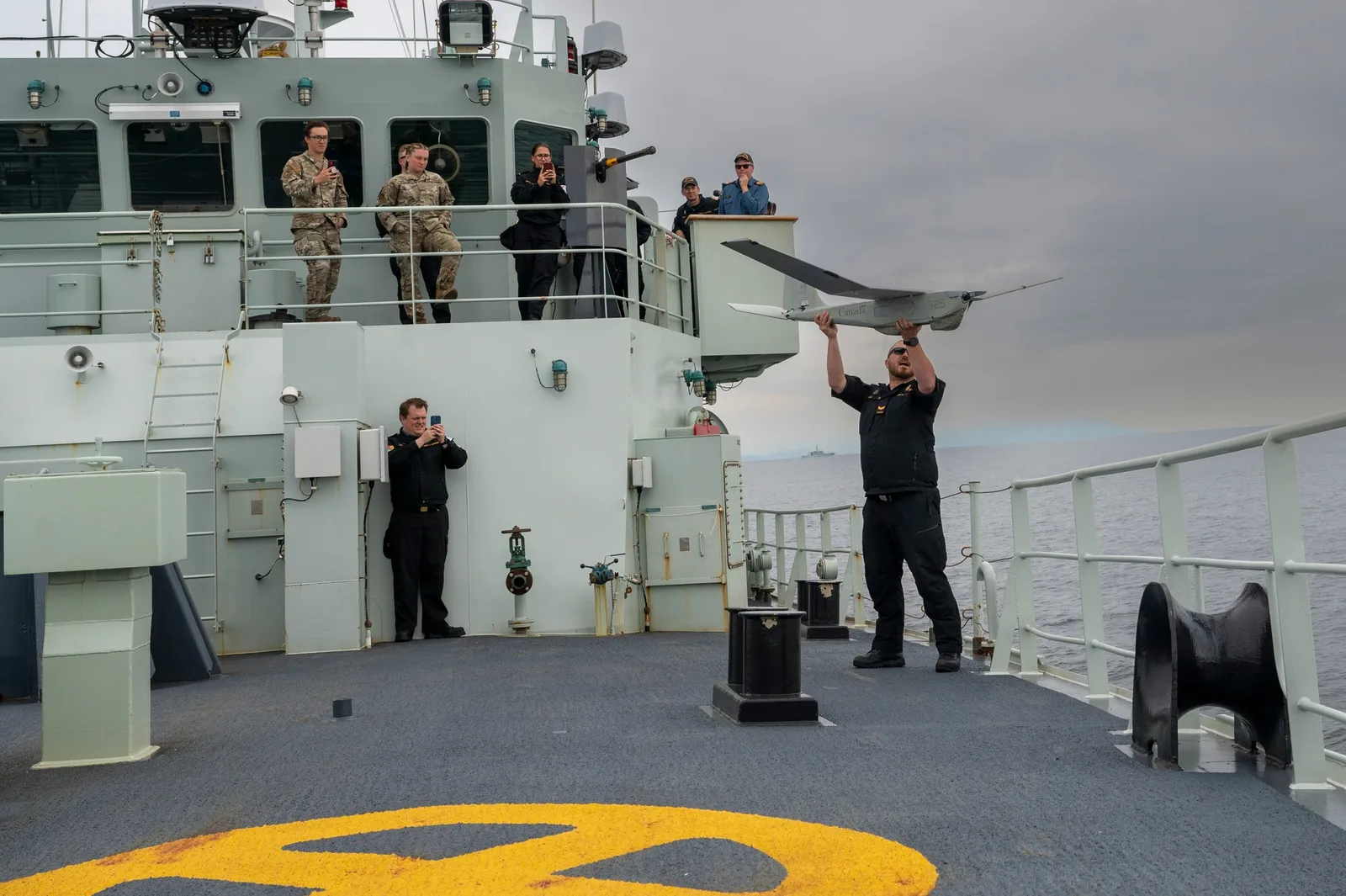
Three weeks after their selection under Canada’s Defence Drone Initiative (DDI), suppliers in the first group of six are expanding capacity. A second intake opens this month.
Government disclosures identify a combination of Canadian-designed systems and foreign platforms licensed for production or supported in Canada. Together, the awards illustrate how Ottawa is putting its Build-Partner-Buy approach into practice for uncrewed systems.
Establishing the Marketplace and Awarding the First Contracts
The Department of National Defence (DND) and the Defence Investment Agency (DIA) introduced the DDI on 23 July, issuing a Request for Supply Arrangement (RFSA) through CanadaBuys, according to DND.
The initial requirements span tactical intelligence, surveillance and reconnaissance (ISR) drones, uncrewed ground vehicles (UGV), and maritime surface and underwater systems. Counter-drone interceptors, drone munitions and deep precision strike are also included.
By 10 September, nearly 400 vendors had qualified as suppliers, the Prime Minister’s Office (PMO) stated in its backgrounder. Canadian suppliers had received up to $50 million in initial contracts, targeting low-cost uncrewed aircraft systems (UAS) and UGVs capable of operating in complex terrain.
According to the government, these purchases would increase the Canadian Armed Forces’ (CAF) drone inventory tenfold. The evaluation preceding the awards included Foreign Ownership, Control and Influence (FOCI) assessments.
The disclosed agreements share a similar structure. Volatus Aerospace and Draganfly each announced five-year contracts comprising a firm order for 100 tactical ISR systems, with options for as many as 4,900 additional systems, according to Investing.com and Draganfly.
Volatus disclosed a $25 million contract ceiling and a maximum price of $5,000 per unit, with deliveries beginning in the fourth quarter of 2026. Draganfly valued its options at approximately $24.25 million if fully exercised, but did not release initial pricing, citing commercial sensitivity.
The Systems and Their Origins
The PMO’s backgrounder identifies the origin of all six selected systems. It described intended awards following evaluation; Volatus and Draganfly subsequently announced their contracts. They fall into three categories: three Canadian designs, one foreign design manufactured under licence in Canada, and two foreign-built systems supported by Canadian companies.
Objexis AI, based in Oakville, Ontario, is supplying the MAQ-C. The government describes the system as designed and built in Canada, with Canadian-owned intellectual property (IP), software, mission systems and flight-control architecture.
Saguenay, Quebec-based Beonyx is supplying the VTSE-TC, a Canadian-designed, owned and manufactured UGV. AVSS, which operates in Fredericton and Carp, Ontario, is providing the Drone D1. Ottawa describes that platform as predominantly Canadian-made, with limited inputs from the U.S., France and the Netherlands.
Draganfly of Saskatoon represents the licensed-production category with its Astiia UAS. Derived from Australian technology, the platform is manufactured in Canada under licence. Its integration, training, sustainment and ongoing development also take place in Canada.
The remaining two systems are built in the UK. Volatus supplies the Huntsman X6, providing Canadian contract management, logistics, training and lifecycle sustainment. Ottawa-based Twenty20 Insight supplies the XRC RHINO, a UK-designed and built UGV backed by Canadian service delivery.
Suppliers Begin Expanding Capacity
Capacity investment is already taking shape among the selected suppliers. On 29 September, Volatus marked the formal opening of a 53,000 sq ft manufacturing and integration facility in Mirabel, Quebec, Canadian Defence Review reported.
Volatus dated its official opening announcement to 29 September; the facility had already become operational in June.
The facility produces drone docking stations and the company’s V-Series aircraft, alongside system integration work. A $35 million public offering in June helped finance the site, with the Business Development Bank of Canada (BDC) also backing the company.
“I have never seen any government move at this speed,” Volatus CEO Glen Lynch told Canadian Defence Review, describing the interval between the DDI’s launch and the award of its first contracts.
Draganfly also closed a US$10 million investment from two U.S. investors this week and intends to expand into Edmonton and Ottawa, CTV News reported. Anvil North examines the investment in a separate article.
The initiative is also creating opportunities for service providers. Top Aces qualified in three DDI streams, covering command and control (C2) and electronic warfare (EW); integration and engineering; and test, evaluation and training, according to Canadian Defence Review.
Through its subsidiary Blue Air Training, Top Aces already employs small UAS in close air support training for allied joint terminal attack controllers (JTAC). The company says this experience provides a foundation for introducing tactical small-UAS training in Canada.
What the First Awards Reveal
The initial selection suggests that Ottawa has prioritized delivery speed over Canadian design origin, while making that trade-off public. Licensed systems and foreign-built platforms can reach operational units sooner than newly developed designs.
However, the requirement for Canadian sustainment retains training, repair and configuration activity domestically, irrespective of where a platform was designed, according to the PMO.
The inclusion of three Canadian-designed systems also gives DND a domestic foundation it can expand through subsequent intakes. For suppliers, the published descriptions of each system’s origins offer a reference point for how Ottawa defines “Canadian” within Build-Partner-Buy.
Three types of supplier stand to benefit from the first wave. Companies offering platforms with Canadian IP – AVSS, Objexis AI and Beonyx – acquire a reference customer that could support subsequent CAF orders and export sales.
Integrators and licensees, including Draganfly, Volatus and Twenty20 Insight, gain access to volume. Over time, these firms could increase their systems’ Canadian content through domestic production of licensed designs or the integration of Canadian subsystems.
Service providers such as Top Aces have a different entry point. They can pursue testing, training and integration work without manufacturing airframes. This segment could expand as the DDI addresses maritime and counter-drone requirements, where integration demands are greater.
Outlook
The October intake will provide an indication of whether the supplier base is moving towards more Canadian designs or a larger share of licensed and Canadian-supported foreign systems. The PMO’s 10 September backgrounder also described a maritime mine-countermeasures competition as imminent. That competition is now open, following publication on CanadaBuys on 10 September.
That procurement extends the DDI beyond low-cost aerial and ground platforms. Maritime systems are larger and more complex, leaving an open question as to whether Canadian designs will secure representation comparable to the first wave.
By disclosing Canadian content on a vendor-by-vendor basis, the DDI has established a reference against which subsequent awards can be assessed. Ottawa should maintain that disclosure for every intake.
Anvil North will record each DDI award in its supply atlas, tracking the vendor, system, design origin, licence source and sustainment terms, beginning with these six suppliers.