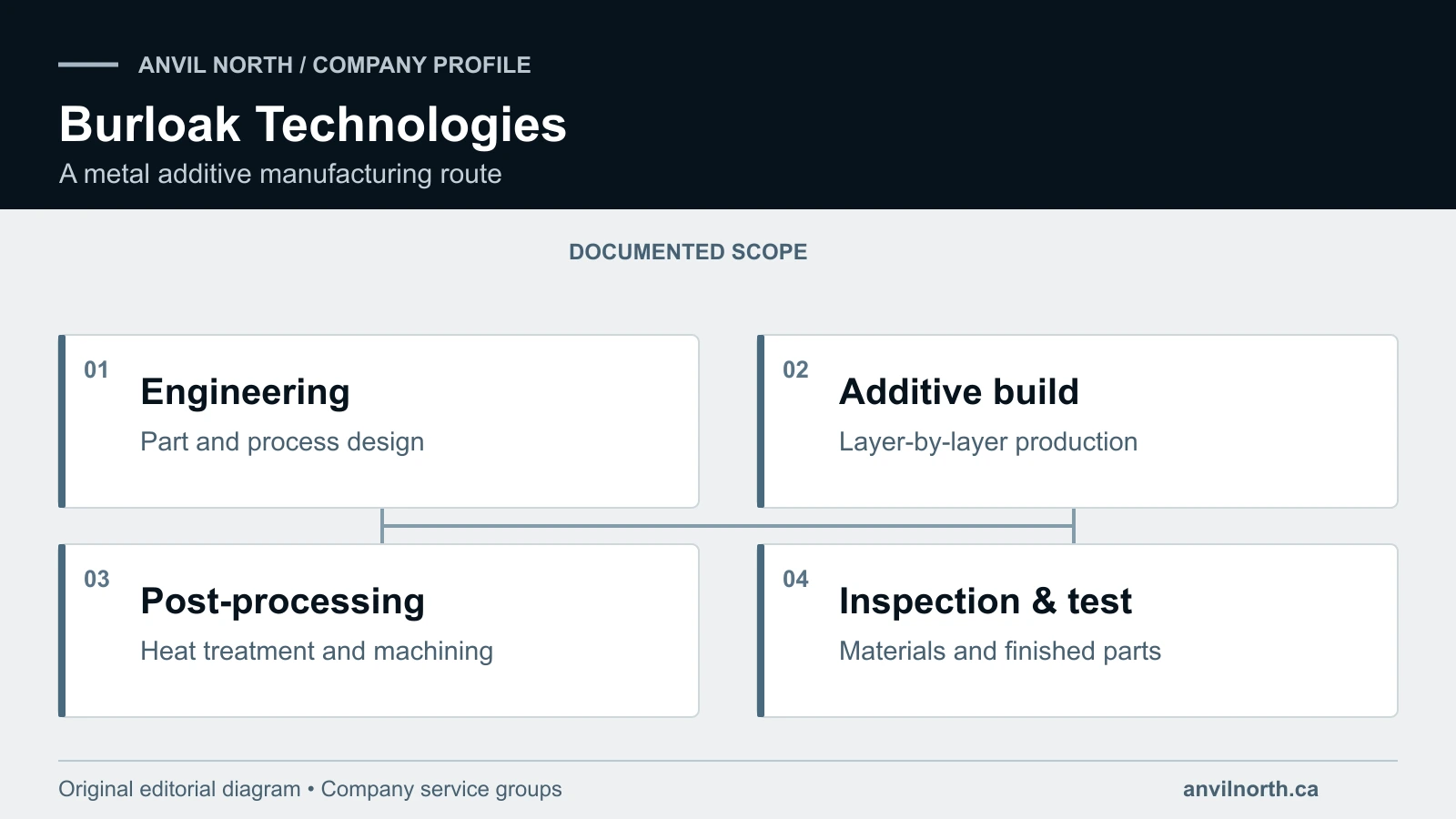
Burloak Technologies makes metal parts through additive manufacturing, with engineering, finishing and testing services. The business operates in Oakville, Ontario, and supports development and shop work. Samuel announced its sale to i3D Manufacturing, effective 12 May 2026. That dated ownership change updates how readers should place Burloak within the wider industrial group.
What does Burloak Technologies do?
Burloak’s additive manufacturing service builds parts by adding material in thin layers. Its work covers early design, build work and the steps that follow a build. The firm offers those stages within a wider metal parts service.
Printing makes the part, while testing checks its materials or traits. Burloak offers both services, which serve different needs within the same build route. Its main role therefore covers manufacturing, with tests as part of that work.
The word Burloak also appears in searches for the surrounding Ontario area. This profile covers Burloak Technologies and its industrial work in Oakville. The business name distinguishes it from other local services and place-name searches.
Who owns Burloak Technologies?
Samuel announced the sale of Burloak to i3D Manufacturing on 12 May 2026. It identified i3D as a division of the BTX Precision group. Samuel said the move to i3D would take effect that day.
The dated sale notice updates older sources that describe Samuel’s ownership. Those earlier sources still help explain Burloak’s past projects and group links. Keep their dates clear when using them to describe the business today.
| Item | Documented position | Reader distinction |
|---|---|---|
| Business | Burloak Technologies | Industrial company rather than a locality search |
| Canadian operation | Oakville, Ontario | Location of the profiled Canadian business |
| Ownership announcement | Samuel sale announcement dated 12 May 2026 | Dated evidence of the transition |
| Acquirer | i3D Manufacturing, a BTX Precision division | Relationship identified by Samuel |
| Earlier Samuel references | Historical ownership context | Preserve the date when discussing prior work |
A change of owner does not qualify a part for use. Buyers still need evidence for the part, material and process they plan to order. The sale notice answers an ownership question, rather than a technical approval question.
How do additive manufacturing, finishing and testing fit together?
Burloak’s application engineering team works on parts, materials and the processes used to make them. The firm describes adapting existing designs and developing routes for new uses. That work helps define how a proposed part will move into production.
Its post-processing range includes heat treatment, machining and work on the part’s surface. Listed processes include hot isostatic pressing, stress relief and other heat treatments. These steps meet needs that the first printed build may not complete.
The materials laboratory tests powder, strength, physical properties and the structure of materials. It also lists computed tomography and coordinate measurement for inspection work. The part’s test plan determines which checks and records the buyer needs.
These stages show why making a part involves more than choosing a printer. Design, material control, finishing and inspection each affect the final result. Conventional machining provides another route to compare against the needs of the part.
What should an additive-manufacturing enquiry include?
Start with what the part must do and its required material. Include the shape, quantities and evidence needed for the buyer’s acceptance. Explain whether the request concerns development or repeat work with an established process.
| Stage | Information to provide | Main question |
|---|---|---|
| Application review | Function, geometry and operating environment | Is an additive route appropriate? |
| Process development | Material and performance requirements | What development and qualification work is needed? |
| Production | Quantities and controlled design data | What process must remain consistent? |
| Post-processing | Heat treatment, machining and finish requirements | What work follows the build? |
| Acceptance | Test plan, inspection and traceability requirements | What evidence completes the order? |
Surface finishing firms cover another step in the wider supply chain for metal parts. Burloak offers several stages that a customer may need within one order. The quote should state which stages and records the supplier will deliver.
Burloak Technologies: common questions
Is Burloak Technologies still a Samuel business?
Burloak’s ownership changed in Samuel’s sale announcement dated 12 May 2026. Samuel named i3D Manufacturing as the buyer and said the move took effect that day. It also identified i3D as part of the BTX Precision group. Older Samuel sources describe its past role, while the sale notice provides more recent evidence of ownership.
What does Burloak Technologies manufacture?
Burloak Technologies makes parts through additive manufacturing for customers in several industries. Its services also cover design, process development, heat treatment and inspection of the work. The range describes a build route rather than one fixed catalogue of stock products. Buyers should state the part, material and performance needed so the firm can assess the proposed job.
Does Burloak only provide 3D printing?
Burloak provides services before and after the stage that prints a part. Its range includes application engineering, machining, heat treatment and tests on materials. These steps help move a design through production to a finished part. Define the stages the customer needs and the records required for acceptance at the end of the order.
Why does post-processing matter for an additive part?
Post-processing completes needs that the first printed build may not meet. Burloak lists heat treatment, machining and surface treatment within this service range. The right steps depend on the part’s material, final size and required performance. Include those steps in the plan so the finished part meets the drawing beyond its first printed shape.
Does Burloak test materials and finished components?
Burloak tests powder, material strength, physical properties and the structure of materials. Its laboratory also inspects parts using methods such as computed tomography. Different tests answer different questions about the material or finished part. The buyer should define those questions and request the lab scope and records that apply to the work.
How should buyers compare additive manufacturing with machining?
Additive manufacturing builds a part by adding material, while machining removes material. Burloak also machines parts as one stage of its post-processing work. Other precision manufacturers offer routes that focus on machining and assembly services. Compare the part’s shape, material, quantities, finish and tests to choose which route deserves a closer review.
Follow Anvil North Weekly for news on Canadian defence suppliers and ownership changes. The company directory covers other manufacturers with links to their stated services.
Sources
- Samuel’s 12 May 2026 sale announcement
- Burloak Technologies
- Additive manufacturing
- Application engineering
- Post-processing and heat treatment
- Materials-testing laboratory
Earlier identity and portfolio references retained from the 13 September profile review: