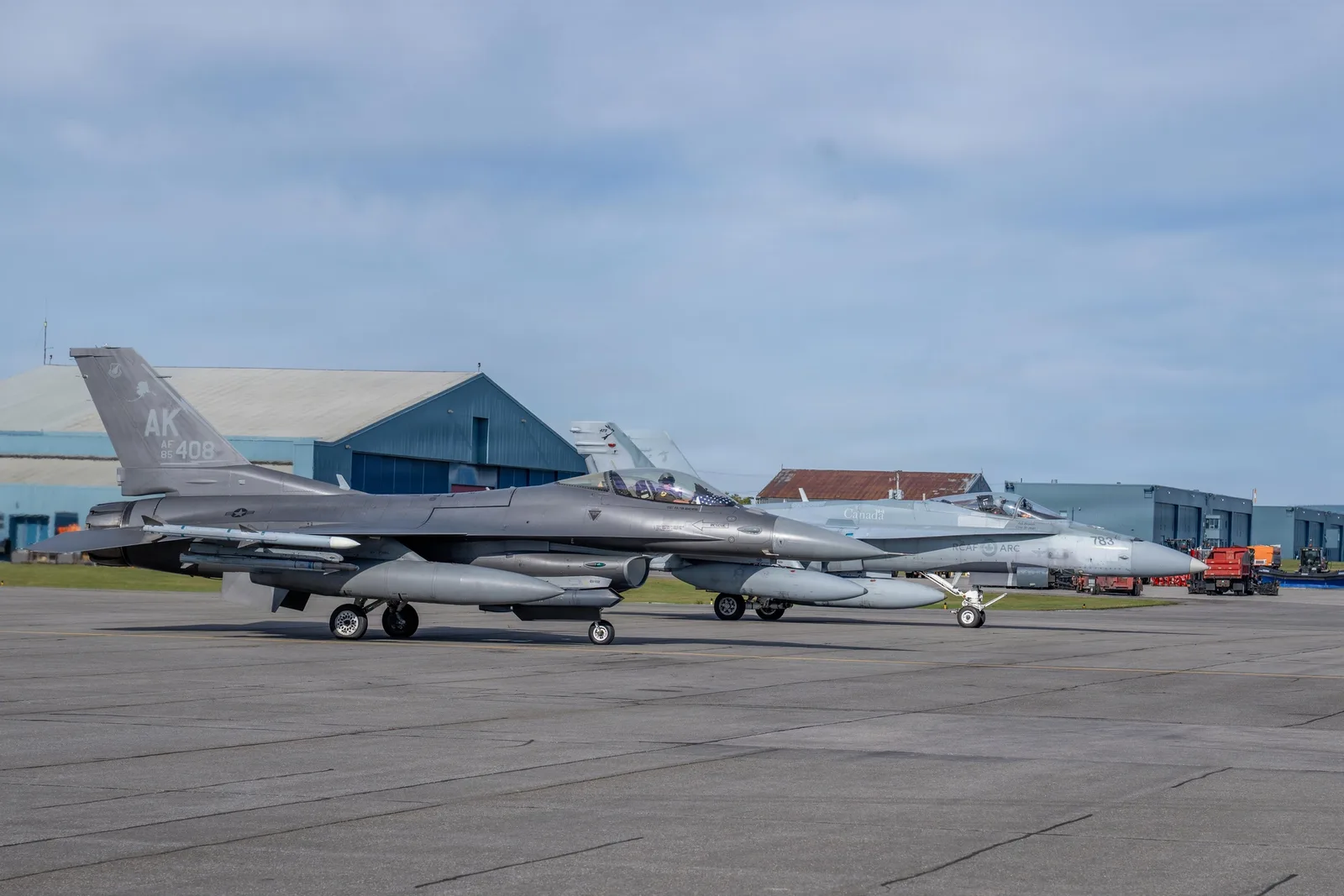
QinetiQ Group Canada, Serco Canada, Des Nedhe Group Defence, Cold Lake First Nations Defence Ltd. and Arcfield Canada formed Team StrīQ on 7 October. The consortium will pursue the Royal Canadian Air Force’s (RCAF) Range Advancement Generation Next & Airspace Revitalization (RAGNAR) program.
The team says its proposal would expand the training ranges at Cold Lake and Bagotville and develop local expertise in Goose Bay. Critical data, security and operational priorities would remain under Canadian control.
Under the roughly C$1 billion RAGNAR project, the air weapons range at Cold Lake, Alberta, and military flying area at Bagotville, Quebec would be transformed into a networked live and synthetic training environment for a fifth-generation air force. The RCAF expects initial operating capability in 2029, followed by full capability in 2031 or 2032.
The initiative first entered the federal procurement process in 2019 as the Fighter Training and Ranges project. Upon reaching the identification phase in 2021, it became Operational Training Infrastructure Enterprise Modernization (OTIEM), before adopting the RAGNAR name earlier this year. Public Services and Procurement Canada released a request for information in January 2026, with industry consultation expected to run through September.
Team StrīQ proposes to integrate live aircraft, synthetic systems, threat environments, telemetry, secure networks, data services and training centres into a single system. Supporting partners include D-TA Systems, Inzpire, the University of Alberta, the Northern Alberta Institute of Technology and Raymond EMC.
Corrie Dale, managing director of QinetiQ Canada, said the need to match Canada’s next-generation aircraft with a next-generation training environment is “the principal driver behind Team StrīQ’s proposal”. QinetiQ highlights its long-term partnering agreement with the UK Ministry of Defence. Serco Canada cites 30 years of working with the Canadian Armed Forces (CAF), alongside its experience in live and virtual training.
Arcfield Canada provides avionics and supply-chain support to the RCAF. As of January, it had about 130 employees, largely based in Alberta, with the remainder in Bagotville and Ottawa. The company had also opened a warehouse at Cold Lake that can be expanded to support the bid.
The Cold Lake Air Weapons Range spans 11,753.5 square kilometres across the Alberta–Saskatchewan border. Cold Lake First Nations Chief Kelsey Jacko said the range lies within the nation’s traditional lands, and that CLFN Defence would contribute Indigenous-led business solutions and regional knowledge to the team.
DNG Defence president Grant Oliver said his company and Cold Lake First Nations want to use RAGNAR to establish Indigenous-owned businesses and long-term careers across western Canada.
Top Aces is also pursuing the program. It said in May that it intends to act as RAGNAR prime contractor, with Raytheon Canada as technical integrator and SGI and CogSim also on the team. Top Aces has delivered adversary air training to the CAF since the early 2000s under the Contracted Airborne Training Services (CATS) program. CATS now runs to 2029, with an option to extend it to 2031.
The schedule is tied to the RCAF’s fighter fleet. Its CF-35A aircraft are due at Cold Lake in 2028, with initial operational capability anticipated in 2029 or 2030.
Team StrīQ did not provide a contract value or timeline in its announcement. The partners said their approach remains subject to Government of Canada acquisition decisions and procurement processes.