.jpg)
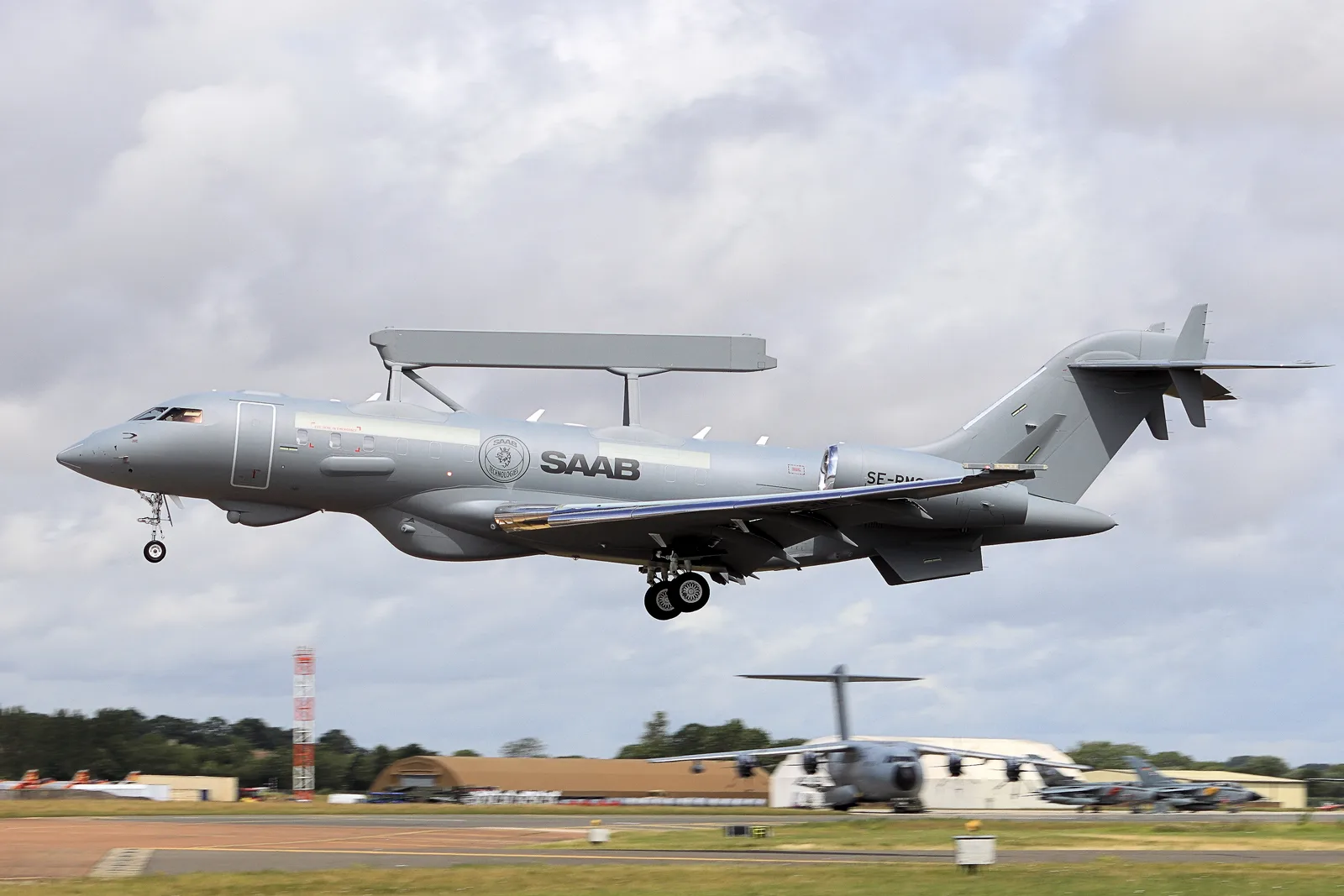
Canada’s Defence Investment Agency (DIA) has signed a non-binding term sheet with Saab for the proposed purchase of six GlobalEye airborne early warning and control (AEW&C) aircraft for the Royal Canadian Air Force (RCAF).
Announced by Saab on 25 September, the agreement establishes the scope of detailed discussions on Canada’s configuration, industrial participation, capability development and program execution, according to Grosswald.
The term sheet is not a purchase contract and places Canada under no obligation to acquire the aircraft, Airforce Technology reported. A contract value and delivery year have not been disclosed.
From Supplier Selection to Negotiation
Ottawa identified Saab as its preferred supplier for a future AEW&C capability on 27 May during the CANSEC trade show in Ottawa, according to Defense News. At the time, the government valued the program at more than $5 billion.
GlobalEye was chosen ahead of Boeing’s E-7 Wedgetail and L3Harris’ Aeris X, according to Grosswald. Canada outlined a requirement to detect, track and prioritize aircraft, missiles, drones and other threats at long range, per Defence Industry Europe.
The proposed acquisition comprises six aircraft together with associated systems, training and support, Armada International reported. Their intended missions include Arctic surveillance and support for Canada’s contribution to North American Aerospace Defense Command (NORAD).
Speaking at the May announcement, Prime Minister Mark Carney described GlobalEye as an important resource for detecting and deterring threats throughout the Arctic, according to Defense News. The report also cited a radar surveillance range of 650 km.
Four months after selecting a preferred supplier, Canada has therefore established a defined framework for negotiating the acquisition.
The Canadian Work Already Attached to GlobalEye
GlobalEye uses the Bombardier Global 6500 business jet, manufactured in Toronto, as its underlying platform, according to Defense News. Airframe production consequently generates Canadian work regardless of which country orders the aircraft.
The May announcement included a broader industrial claim. Defense News reported that at least one-third of a projected 40 allied GlobalEye orders over the next 15 years would be built in Canada.
However, producing the airframe is distinct from supplying and integrating the mission equipment. GlobalEye’s radar, mission systems and integration are Swedish, and the term sheet does not identify how much of that activity might be transferred to Canada.
The industrial negotiation is therefore largely about the work beyond the airframe: mission-system integration, sustainment and training. The DIA and Saab must now establish the extent of Canadian participation in those areas.
More Allied Customers, More Potential Work
GlobalEye has strengthened its position among allied customers since Canada’s May selection. NATO chose the platform to succeed its E-3 fleet, while the Netherlands and Sweden signed an agreement for a pooled fleet that would give the Dutch access from 2028, according to Grosswald.
Canada also identifies France and the United Arab Emirates (UAE) as countries that have selected, or intend to select, GlobalEye, per Defence Industry Europe.
Additional customers expand the production line that Canada would enter. Because the Canadian industrial claim is linked to allied purchases, growth in the order book also increases the potential volume covered by a Canadian workshare.
The Stakes for Canada and Saab
Canada has more to gain from participation in an expanding allied production program than from work confined to six aircraft. Canadian integration or maintenance, repair and overhaul (MRO) responsibilities for allied fleets could grow alongside NATO and European orders.
An agreement limited to Canada’s aircraft would instead restrict that benefit to the domestic fleet. Whether the industrial package extends beyond those six aircraft appears to be a central issue for the DIA.
For Saab, the Canadian purchase would add a North American customer with a NORAD mission, alongside a second industrial base already connected to the company through its airframe supplier. It would also reinforce GlobalEye’s position outside Saab’s European customer base.
The acquisition can therefore reasonably be viewed as part of Saab’s broader effort in Canada. Whether the company will connect its AEW&C industrial proposal to other Canadian requirements during the negotiations remains unclear.
Three Areas for Canadian Suppliers to Follow
The first is the aircraft’s configuration. Decisions about Canadian sensors, communications equipment and NORAD-interoperable systems will determine which suppliers can participate in the delivered capability.
The second is in-service support (ISS): where the work will take place and which Canadian company Saab will select as its partner. The third is training, particularly whether simulators and aircrew instruction will be provided in Canada.
Neither Canadian mission-system partners nor ISS partners have been publicly identified. As the configuration takes shape, established Canadian aerospace companies with Bombardier experience, RCAF sustainment work or simulation capabilities could position themselves for these packages.
Outlook
The GlobalEye term sheet begins a major DIA negotiation with industrial participation included from the outset. For Canadian companies, the eventual value will depend on whether the agreement provides access to the wider allied production line or limits their role to Canada’s own fleet.
The DIA’s approach could also establish a reference for other acquisitions of foreign systems, including the Canadian Patrol Submarine Project (CPSP).
The next milestones are a signed contract, its disclosed value, a first delivery year and the identification of Canadian partners. Anvil North will follow these developments on its program pages.