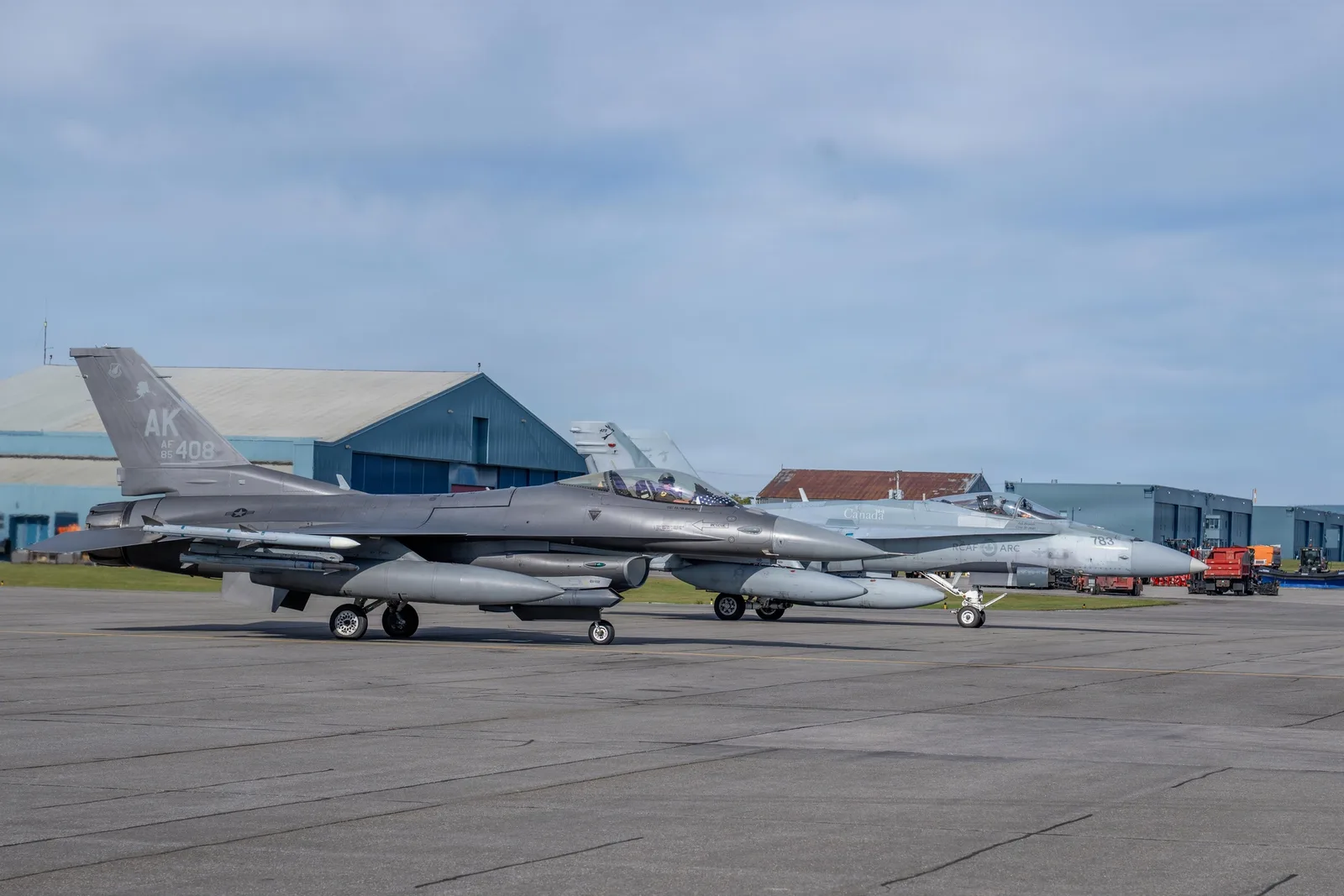
More than 200 personnel and 19 aircraft took part in Operation Arctic Vanguard 26 across Labrador and Greenland from 13 to 26 September, according to an account published by the Department of National Defence on 8 October.
The North American Aerospace Defense Command (NORAD) operation was hosted primarily from 5 Wing Goose Bay. It brought Canadian, American and Danish forces together with a NATO E-3 airborne early warning and control aircraft.
Canada contributed CF-18 fighters, CC-130 Hercules aircraft, a CH-149 Cormorant and a CH-146 Griffon. They operated alongside U.S. Air Force F-16s and Royal Danish Air Force F-35s.
NORAD operations draw on several aircraft roles
DND described the operation as an opportunity to improve interoperability and readiness for the aerospace warning and control missions supporting North American defence.
The participating fleet brought together fighters, transport aircraft, helicopters and airborne surveillance. That mix illustrates the range of aircraft and support functions involved in maintaining an allied presence across the northern approaches.
For Canada, Goose Bay provided a base from which those capabilities could operate together. The activity offers a practical example of the missions that northern infrastructure must support.
Goose Bay infrastructure work advances separately
The operational account follows the start of construction on Goose Bay’s new central heating plant on 2 October.
The plant forms part of a $187-million energy performance contract awarded to MCW Custom Energy Solutions in December 2025. The wider project is intended to replace diesel heating with electricity from Labrador’s grid and retains a December 2030 completion target.
Anvil North’s earlier reporting also identified a government commitment of up to $8 billion in long-term investment at Goose Bay as a NORAD northern basing infrastructure site. That ceiling covers a broader prospective investment program than the heating contract.
Arctic Vanguard and the construction project are separate developments. Together, however, they place the base’s current operational role alongside the infrastructure work intended to sustain it. For industry, the relevant opportunities will emerge through specific construction and support procurements as those investments are defined.
Related coverage: Construction starts on Goose Bay’s $187-million energy contract.