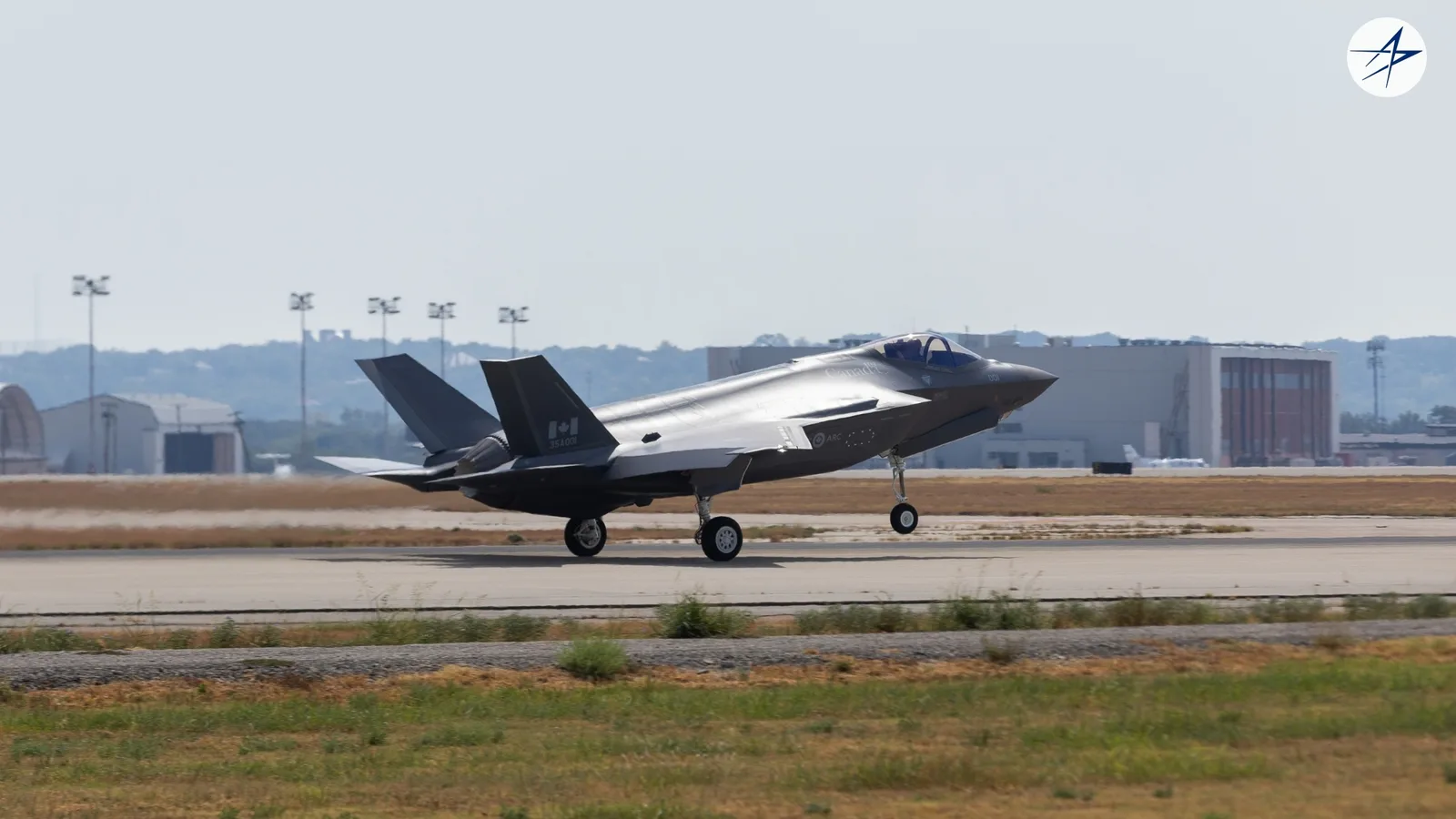
Canada’s first F-35A Lightning II took to the air on 23 September 2026, completing its first flight from Naval Air Station Joint Reserve Base Fort Worth in Texas. Built for the Royal Canadian Air Force (RCAF), the aircraft carries construction number AR-1. It departed at approximately noon local time, accompanied by an F-35C safety chase aircraft.
There was no official announcement or ceremony for the flight. The RCAF confirmed that the test had taken place but issued neither a statement nor a press release. The aircraft already displays bilingual intake markings, along with a roundel and “Canada” lettering behind the cockpit.
Designated CF-35A in Canadian service, the fighter is succeeding the RCAF’s CF-188 Hornets through the Future Fighter Capability Project. Canada became a Level 3 partner in the F-35 program in 2002. It chose the F-35A in 2022 and concluded an agreement the following year for 88 jets, with an estimated cost of C$19 billion.
By February 2026, AR-1 had reached the final assembly stages at Lockheed Martin’s Fort Worth plant. DND marked that production milestone with a ceremony at which RCAF commander Lt.-Gen. Jamie Speiser-Blanchet was to sign the aircraft’s fuselage bulkhead.
The contractual commitment covers only a portion of the planned fleet. Canada has ordered 16 F-35s and started paying for components for another 14. These long-lead items require orders years ahead of production to preserve Canada’s position in Lockheed Martin’s manufacturing schedule. DND has not confirmed a formal commitment to buy additional aircraft.
The wider purchase remains subject to a review ordered by Prime Minister Mark Carney in March 2025. Its findings have not been published. Carney has discussed limiting the F-35 order and adopting a mixed fleet, potentially involving Canadian production of the Saab Gripen E.
The decision carries implications for Canadian suppliers already involved in the program. Lockheed Martin says more than 110 Canadian companies have participated in the F-35 supply chain, with over 30 remaining active. According to the company, every aircraft contains more than C$3.2 million in Canadian-made components. Its projection of more than C$15.5 billion in Canadian economic value through 2058 depends on Canada purchasing all 88 jets.
Domestic support preparations are also advancing. DND’s 2026–27 Departmental Plan commits to a sovereign Intelligence Mission Data Production Trial, intended to supply reprogramming data for the F-35 and other fifth-generation platforms. The trial is due to begin during fiscal year 2026–27.
The RCAF has established its first CF-35A training squadron at Luke Air Force Base in Arizona, where pilot training is scheduled to start later this year. Maintenance technicians are expected to receive aircraft training at Eglin Air Force Base in Florida. Canada’s first jet is expected to arrive at Luke by the end of 2026.
An initial CF-35A arrival in Canada is expected in 2028. A squadron is anticipated to reach initial operational capability in 2029–2030, followed by full operational capability in 2032–2034.
The CF-35A represents the largest procurement in RCAF history. It sits within a broader fleet transition that includes the P-8A Poseidon, MQ-9B SkyGuardian and a new airborne early warning and control aircraft. The future of the remaining 72 aircraft in the original 88-jet plan remains uncertain pending the purchase review’s conclusion.